| The Thorn
Tree Project
The story of the Thorn Tree
Project is a story of how, against all odds, the nomadic people
of Sereolipi in the northern arid lands of Kenya, through hard
work, resourcefulness and with a little help from the outside
world, have begun to create significant, meaningful and measurable
change by providing education for their children.
 |
The mothers and fathers
of Sereolipi and Ndoyo Wasin |
There are two primary schools
in the Sereolipi area – Ndonyo Wasin Primary School and
Sereolipi Primary School. In 2001 there were only 130 children
attending these two primary schools and this was less than 3%
of the children in the area. Yet the people believed that education
was a key to their survival in the 21st century. It was the best
thing they could do to improve the socio-economic structure in
their communities and thereby create significant and lasting change
in the lives of their children.
 |
| The children of Sereolipi
and Ndonyo Wasin |
Their goal was to get as many
children of the nomadic families to come to school as possible.
However, Northern Kenya is one
of the poorest and most marginalized areas in Africa and the average
annual income in the Sereolipi area is less than $250 a year.
Even the most basic initiatives are beyond their financial means.
In addition, the Samburu community is nomadic and most children
live 10 to 40 miles away from these primary schools. The parents
themselves had never been to school and had little understanding
of what going to school entailed. They were reluctant to send
their 6 year olds to a strange school so far away – particularly
when they had an important role in looking after the goats and
cattle at home.
 |
| Walking to school |
School
photo for Ndonyo Wasin |
School lunch |
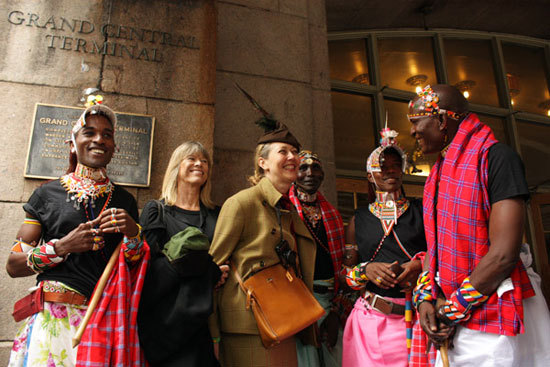
Jane Newman first met the people
of Sereolipi when she was driving from Nairobi to Addis Ababa
and the car she was in broke down in their village. At that time
Jane was working in advertising in New York City. The following
year she retired and she returned to stay with them for a month.
She realized that their dream was worthy and their ideas were
good but they had no chance of making it happen simply because
they had no money. She helped them set up Sereolipi Nomadic Education
Trust in 2001 and decided to raise funds for them through friends
and business associates in the US and Europe.
The
first initiative of the project was to establish some preschools
in the outlying nomadic communities where the parents could see
the benefits of school first hand.
 |
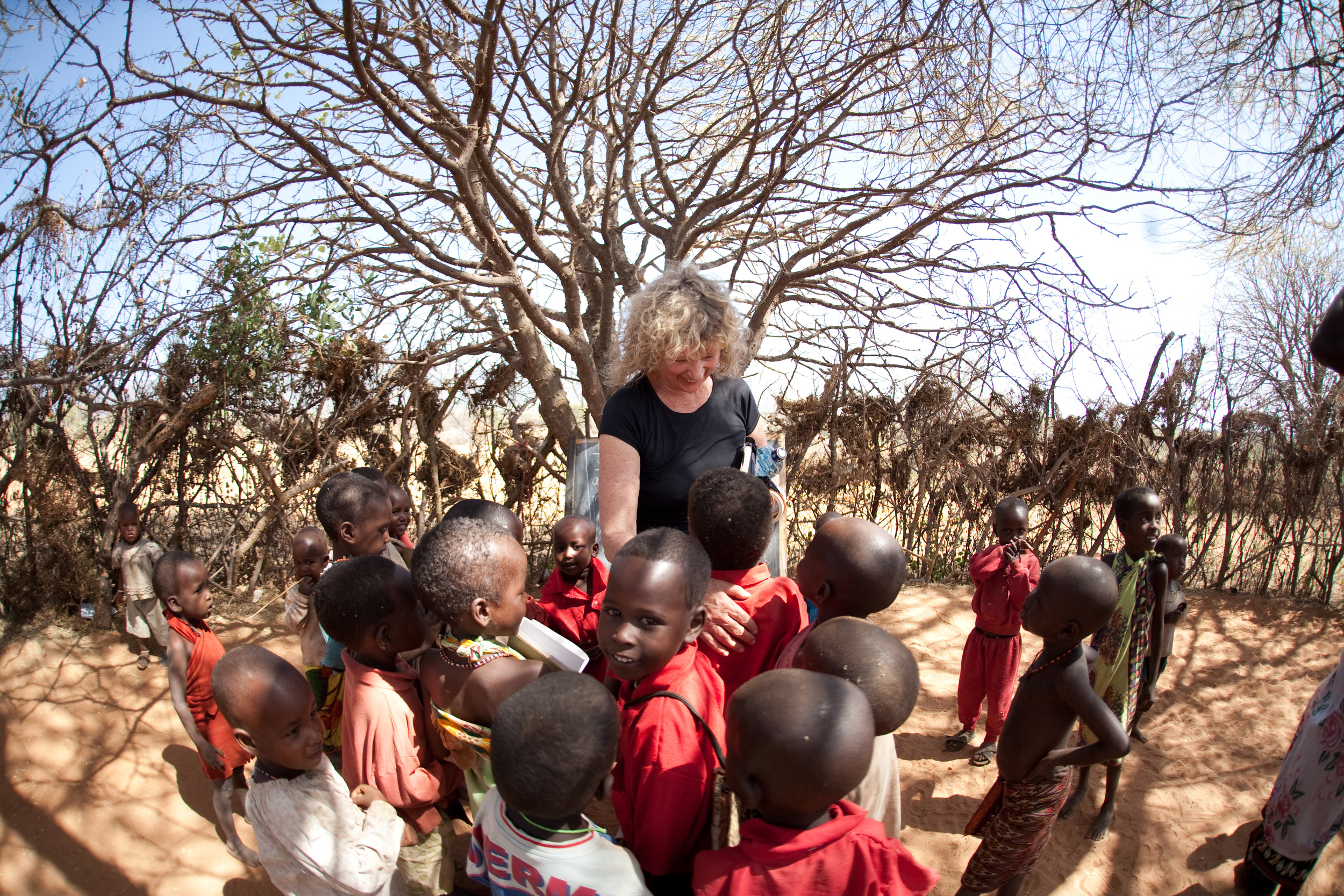
The thorn
tree preschools use the largest thorn tree around as the
classroom |
The preschool classroom is
under a thorn tree with a blackboard propped against the tree
trunk this is used to teach 25 to 35 tiny children to read, write,
add and subtract. The schools are managed by an active committee
of men and women elected by the communities. And the school is
very much part of the culture.
 |
Learning
under the thorn tree |
Two preschools were opened in
2003. They proved to be very successful at sending students into
the primary schools so more were added and now there are 14 of
them. Each preschools is supported by a sponsor in the USA/UK
who donates $1,000 a year for the salary of the teacher, food
for lunch and a cook to make it as well as blackboards and books
to teach with.
 |
| Three of the preschool
teachers |
one
of our school committees |
Jane with
the children |
As the preschools brought more
and more students into the two local primary schools it created
the need for dormitories. Almost all the nomadic children have
to board at the school because their families live and migrate
anywhere from 10 to 40 kilometers from the two schools. The existing
dormitories were extremely overcrowded.
 |
Some of the pre-school
children |
The
second initiative was to build two dormitories for girls
and two for boys in each of the two primary schools. People in
America donated enough money for these eight dormitories complete
with shower blocks and toilets and fully equipped with new bunk
beds, mattresses and sheets. Solar lighting was installed.
 |
Our new dormitories |
As well as the dormitories other
aspects of the infrastructure needed to be improved to cope with
the influx of students. More desks and school uniforms were bought
every year for both schools.
 |
Children
learning on the floor before we bought 50 new desks |
Water was put into Ndonyo Wasin
primary school because the students were walking 4 kilometers
a day to fetch water from and open well dug in a dry river bed.
A large airy computer room with internet access and a library
were added to Sereolipi school. An ambulance and nurse were brought
in to look after the health of the students in the primary schools
and preschools. Camels were bought to give the students extra
nutrition and an evening meal was given to Ndionyo Wasin boarders.
 |
| |
The new ambulance
in action |
|
clean, running
water! |
These activities have been enormously
successful at bringing students to school.

The number of children attending
primary school has increased from just 132 students in 2001 the
year before we started to 630 in 2008/9. In addition there are
over 400 students attending the 12 preschools so we have about
1,000 students in total at school.
 |
| Preschool
teachers with the students they taught who are now at
primary school |
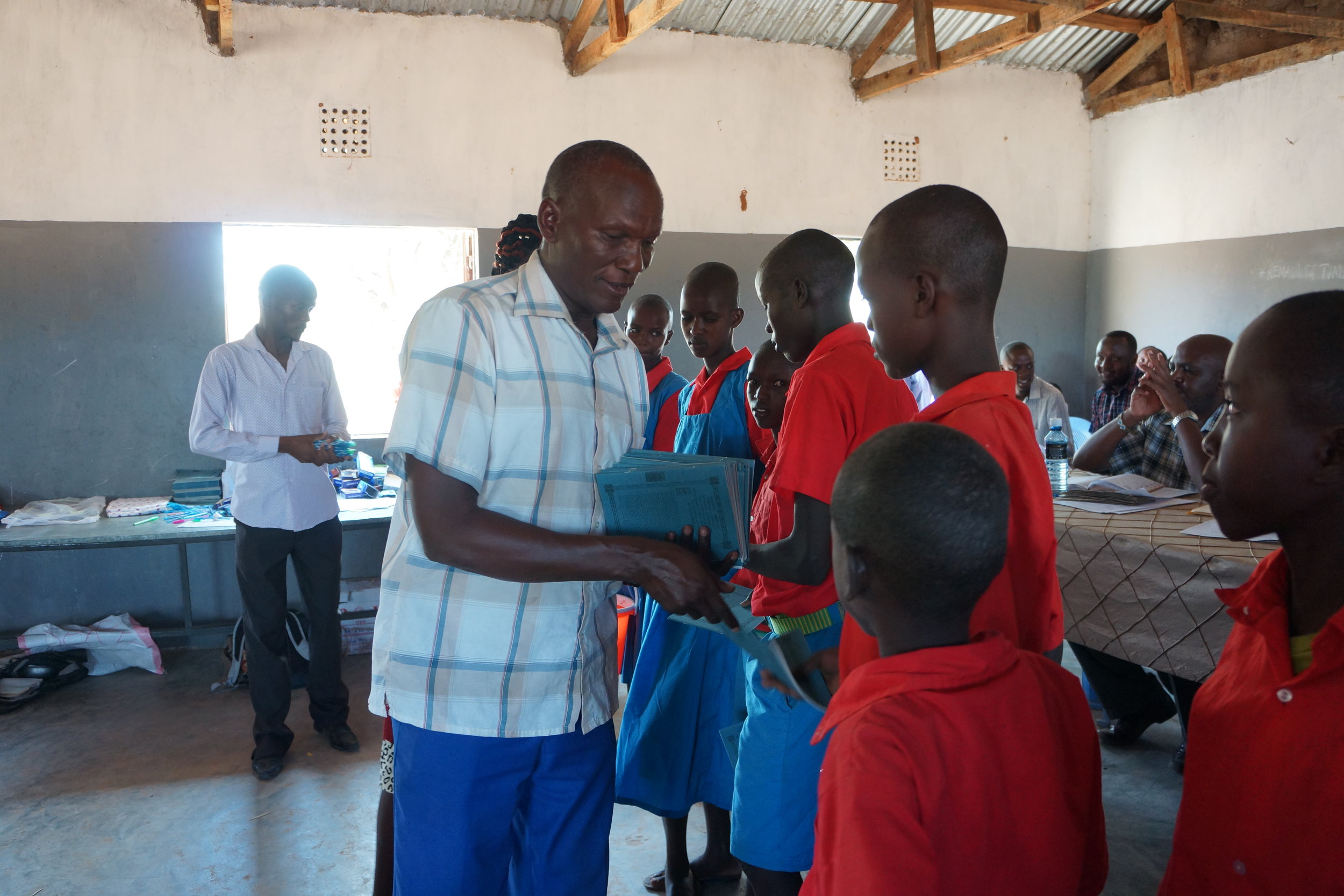
The
third initiative was begun in 2006 and its goal was
to set up a scholarship program for students graduating
from the primary schools. Secondary school is not free in
Kenya and the cost of school fees, supplies and transport
to send a student to secondary school was nearly three times
the parent’s annual income and it was simply impossible
for the parents to pay. The program looks for individual
sponsors in the US/UK who are interested in helping one
of this bright students to realize their dream and the sponsor
pays $1,000 a year to send the student to one of the best
secondary schools in the country. We now have 50 students
in the scholarship program. For more information on the
scholarship program go to http://samburuscholarshipprogram.googlepages.com
 |
| |
some
of our scholarship students with their families and
at school. |
|
The
fourth initiative was started last year in Ndonyo
Wasin Primary School which has 240 students enrolled (up
from only 32 in 2001). Its goal was to improve the quality
of education the students were receiving so that more and
more of them would qualify for the scholarship program which
required a pass mark of 300 out of 500 in the primary school
exams.
In rural schools in Kenya
the government provides less than 45% of what is needed
to run a basic school capable of delivering adequate academic
standards. In our schools the situation was even worse.
In 2007 the Kenyan government gave Ndonyo Wasin only 30%
of what the school needed to function at a basic academic
level. For example the school had only 3 teachers when there
were 8 classes from Standard 1 to 8. The government supplied
only basic food of corn and cow peas for lunch even though
the school is 100% boarding and the students need breakfast
and dinner as well as lunch. The government only supplies
enough money for text books for one subject text book to
be shared by 3 to 4 students and no English or Kiswahili
reading books. Not surprisingly and in spite of all the
efforts of the head teacher, the school was not doing well.
 |
| Old classroom |
new classrooms |
|
It was agreed that we
would supply the other 70% the school needed for one year
to see if it would help increase grades. We added 8 teachers,
bought Unimix (a nutritionally balanced porridge) for breakfast
and ugali and beans for dinner. We built an new kitchen
with energy efficient stoves and also a new library that
has about 2,500 reading books in it. And we have added 3
new large,light classrooms. Our stated goal was to make
sure that all the students achieved 60% or more in all their
5 subjects.
 |
| the old
kitchen |
the new
kitchen |
|
the new
library |
| The
results were excellent – a 20 to 30% increase
across all classes. There was still lots of room for
improvement but it was good enough to continue in
Ndonyo Wasin and to extend it to Sereolipi Primary
school in 2009. We also agreed to add in a third school
in our area called Lerata that had 130 students enrolled
in it.
 |
|
New school uniforms |
unimix
for breakfast
|
Through all of these
activities Jane Newman works closely with the community,
teachers, head teachers, and school committees to
ensure the project is well managed and that each activity
has clear objectives and is fully evaluated on an
annual basis. Jane travels to Sereolipi, Ndoyo Wasin
and Lerata and visits the primary schools and pre-schools
at least four times a year.
None of this
would have been achieved without the generous support
of all the people who have donated money to the project
over the past 7 years. It has been amazing what has
been accomplished and the Samburu people are extremely
grateful and so very appretiative. They send blessings
to all who have helped them.
 |
The
computer room |
camels
give 8 times more milk than cows |
|
|
|